Integrate
Integration guide
For a merchant's backend team, who connect the merchant's Phala Pay account (acct_…) to the
API. Phala Pay is open-source, self-hosted software: your operator runs its own instance
(self-hosting), and you integrate with that instance, at the service URL the
operator gives you (its public origin); Phala offers no hosted service. The samples write
it as https://. Phala Pay is API-only: the operator creates your account
(§5.1), and you manage everything else with your API keys and the SDKs; there is no dashboard.
Phala Cloud integrates exactly this way, as an ordinary account of Phala's own instance. Where
this guide and the code disagree, the code wins. The contract is defined by:
- crates/
topup/ : every request and response shape, with an example of each, also served atopenapi. json GET /openapi.jsonand published as the API reference (itsErrorssection is where each error'sdoc_urlpoints); the operator's admin API is the separateopenapi.;admin. json - deploy/
product/ : a complete Python merchant backend (fulfillment, holds, refunds), run on Phala's staging;reference_ product - architecture.md: the specification, especially §11 (the fulfillment webhook), §12 (API, events, customer UI), §14 (attestation, restore), and §15 (refunds and policies).
Phala Pay has the Python SDK and three lockstep JavaScript packages, all in this repository:
- sdk/python,
phala-pay(importphala_pay): the backend client,PhalaandPay(... ). quotes. create(... ) .webhooks.in Stripe's shape, overconstruct_ event(... ) topup_sdk(signing, verification, address recomputation,topup-sdk send-test-event) andtopup_client, generated from the OpenAPI document. - sdk/js,
@phala/pay: the framework-free browser checkout core, retrieval and wallet helpers, payment options, payment URIs, icons, formatting, and public types; - sdk/js-react,
@phala/pay-react:<PaymentElement>,<Checkout>,<DepositAddress>,<Payment, hooks, icons, and styles for React;Option Picker> - sdk/js-server,
@phala/: the merchant client and API types;pay- server @phala/: offline webhook verification, address recomputation, ledger helpers, andpay- server/ helpers flushTransaction/safeBatchbuilders.
Samples below use them; every step is plain HTTP and ed25519, so any backend language can do the same.
Contents: Quickstart · 1. Quotes (and deposit addresses, treasuries, sweeps) · 2. Webhooks and fulfillment · 3. Refunds · 4. Testing and go-live · 5. Reference
Planned upgrades and reconnecting
An upgrade restarts the attested CVM. While the old process drains, new mutations return
503 service_ with Retry-After: 5; no handler ran and the same Idempotency-Key can
be retried. Reads continue until the restart. During the restart, the gateway can return
connection failures or 502/503/504 without Retry-After (sometimes HTML). The observed staging
upgrade was unavailable for about 160 seconds. Payments remain on-chain and are scanned after
restart; webhook outbox delivery retries automatically.
For merchant backend work that can wait, enable SDK upgrade tolerance:
import { PhalaPay } from "@phala/pay-server";const pay = new PhalaPay({ apiKey, pins, upgradeTolerance: true });const created = await pay.quotes.create(params, { idempotencyKey: orderId });Python uses the same opt-in:
from phala_pay import PhalaPaypay = PhalaPay(api_key, pins=pins, upgrade_tolerance=True)created = pay.quotes.create(**params, idempotency_key=order_id)It retries GETs and idempotent POSTs through those failures for up to five minutes, with bounded
backoff, one body/key, and cancellation support. The opt-in keeps the normal interactive defaults
(15 seconds per attempt, four attempts, 60 seconds total) intact. Explicit request
or Python request_deadline settings remain hard limits. Enable it per call with
{ upgrade or Python upgrade_, or disable it per call on an
enabled client. Python interrupts (Keyboard) terminate retries, including waits;
run synchronous SDK calls in a worker thread in async routes. Keep your application's request budget
long enough, or create the payment asynchronously and let the payer wait. On deadline exhaustion,
preserve the order's key for a later retry; do not turn an uncertain network outcome into a new
logical payment.
<Checkout> and <DepositAddress> from @phala/pay-react poll through temporary 5xx/network failures automatically,
retain the last view and selection, show a neutral reconnecting message, and resume once reachable.
They do not create a new checkout. Normal invalid-secret and address-mismatch handling remains.
Both SDKs follow the
SDK contract amendment.
Quickstart
The whole integration is three pieces, as with Stripe's Payment Element with a deferred intent: the browser renders the payment, the backend creates a quote when the payer submits it, and the webhook fulfils.
Install @phala/pay, @phala/pay-react (for React), @phala/, and phala-pay
from npm/PyPI at your operator's service version,
and pin it (§5.9, "Compatibility"; X.Y.Z below):
npm install --save-exact "@phala/pay@X.Y.Z" "@phala/pay-react@X.Y.Z" "@phala/pay-server@X.Y.Z" viem react react-domuv add "phala-pay==X.Y.Z" # or: pip install "phala-pay==X.Y.Z"Configure. PHALA_ is your operator's service URL. The operator creates your
account and sends your contact its first secret key,
ppay_sk_test_… (§5.1); roll it at once ({"expires_in": 3600}, then revoke it with the new
key) and keep the new key offline, for administration.
Create a restricted key for your servers (§5.4). Pin your account's webhook key for the mode from
its attestation (§5.3). Set your treasury on each chain you accept (§1.6): payments go only there,
and quotes answer 400 treasury_not_set until it is. Then choose what you accept: an account
accepts nothing until its payment settings list the chains and assets it takes, in each mode
(POST /v1/ with the secret key, §1.9); quotes and deposit addresses answer
400 asset_ until they do.
Pin your addresses (required). Configure in your own server, never from an API response, the
inputs every address you show is recomputed from: your account id (acct_…), the forwarder
factory and implementation of the attested deployment (§5.5), and your own treasury on each
chain, as you proved it. The SDKs derive each address from these pins, never from the
response's treasury: a compromised service could return an attacker's treasury together with the
valid CREATE2 address of that treasury, which a check over the response's own treasury would
pass. Pins-based clients fail closed without every pin (Address). The low-level
Python TopupClient permits a test-mode fallback to the response's treasury with a warning.
1. Backend: create a quote for the chosen token, return its checkout params. The browser calls
this when the payer submits, with the token and network they chose and the idempotency key the
payment element made for this quote; check them against what you accept (GET /v1/config) before
quoting. Use that key, not an order id, as the quote's idempotency_key: the element makes a new
one for each quote the payer asks for (another token or amount, or a new quote after one ended)
and repeats it only to retry a request that failed with the same option and amount, so a retry
returns the quote a lost response created.
Repeating a key with another body is 400 idempotency_. Only the create response
carries client_secret; repeating the call with the same key within 24 hours returns the same
response, secret included.
from phala_pay import PhalaPay# PHALA_PAY_API_KEY is your server's restricted key, "ppay_rk_test_…" or "ppay_rk_live_…" (§5.4).# PHALA_PAY_PINS encodes your service origin, account, attested forwarder and webhook keys,# and your own treasury on each chain (§5.3, §5.5). Every quote's address is recomputed from these# pins before it is returned, and one you cannot derive raises.pay = PhalaPay.from_env()@app.post("/topups")def create_topup(body: TopupRequest, team: Team = Depends(current_team)) -> dict[str, str]: quote = pay.quotes.create( client_reference_id=team.id, amount=body.amount, chain_id=body.chain_id, asset=body.asset, idempotency_key=body.idempotency_key, # from the payment element; check it is a UUID metadata={"order_id": body.order_id}, ) return {"clientSecret": quote.client_secret, "expectedAddress": quote.address}2. Frontend: render the payment element. <PaymentElement> offers the tokens and networks you
accept (pass GET /v1/config's assets from your backend through paymentOptions), creates
nothing until the payer submits, then calls your createQuote with the chosen option and shows the
quote's checkout: a browser wallet (EIP-6963), a QR code (EIP-681), and manual payment, with live
status until the payment is credited. It reads the quote's public view with the client secret (no
signature, CORS *).
"use client";import { paymentOptions } from "@phala/pay";import { PaymentElement } from "@phala/pay-react";import "@phala/pay-react/styles.css";<PaymentElement options={paymentOptions(config.assets)} // from your backend's pay.config.retrieve() amount={2500} // US cents, for the button: "Pay $25.00 in USDC" apiBase={PHALA_PAY_API_BASE} createQuote={(option, { idempotencyKey }) => post("/topups", { amount: 2500, chain_id: option.chain_id, asset: option.asset, idempotency_key: idempotencyKey, order_id, }) } onSuccess={() => router.refresh()}/>createQuote resolves with { clientSecret, expectedAddress } (or pay. from
@phala/, which also names apiBase); a rejection shows "Could not start the payment.
Try again." and calls onError. expectedAddress is required: it is the address your backend
recomputed, and the checkout fails closed, showing nothing to pay, when the quote it reads names
another one. To submit with your own button, pass hideSubmit and put your summary and
type="submit" button in the element's children (or give a button elsewhere type="submit" form={id} with the element's id). create adds one line after the button, "Paying
from an exchange? Use a deposit address" (§1.5). appearance themes it to
match the page, a test-mode quote says "Test mode", and onChange reports each step and every
checkout status change (§1.2).
For a quote you already created, render <Checkout clientSecret expectedAddress apiBase> alone;
<Payment is the element's token and network choice on its own. Without React,
new PhalaPay({ apiBase }). gives the same live
status.
3. Webhook: verify, then apply the deposit. Every deposit.* event carries the whole
deposit; apply it to client_'s balance per deposit, serially, by the balance rule
(§2.3), commit, then answer 2xx; onSuccess in the browser is display only (§2).
from phala_pay import SignatureVerificationError@app.post("/webhooks/phala-pay")async def webhook(request: Request) -> Response: try: event = pay.webhooks.construct_event( await request.body(), request.headers, WEBHOOK_KEYS, ACCOUNT, expected_livemode=False ) except (SignatureVerificationError, ValueError): return Response(status_code=400) if event.type.startswith("deposit."): # Credit, refund, and reversal alike: merge the snapshot and move the balance by the # change in what the deposit nets to, in one transaction per deposit (§2.3). apply_deposit(event.deposit) return Response(status_code=200)A Node backend verifies the same way with construct from @phala/.
sdk/apply_deposit) and tests of partial refunds,
reversals, and out-of-order delivery; Phala's staging reference product runs the Phala Pay demo, a
cloud console's billing page, on pay.phala.com.
1. Quotes
1.1 How it works
A quote is the way to pay a known amount, as a PaymentIntent is in Stripe: the user states an
amount in dollars and receives a locked price, an exact token amount, and a single-use address to
pay within the window. A quote is a payment instruction at a locked price, not a guarantee of
payment in full: an underpayment, an overpayment, or a late payment to its address is still
credited, at spot, for what arrived (§1.3). Treat an order as paid in full only when the deposit's
price_source is quote (or its amount is what you expected). For top-ups within your deposit limits at any time, give the customer a persistent
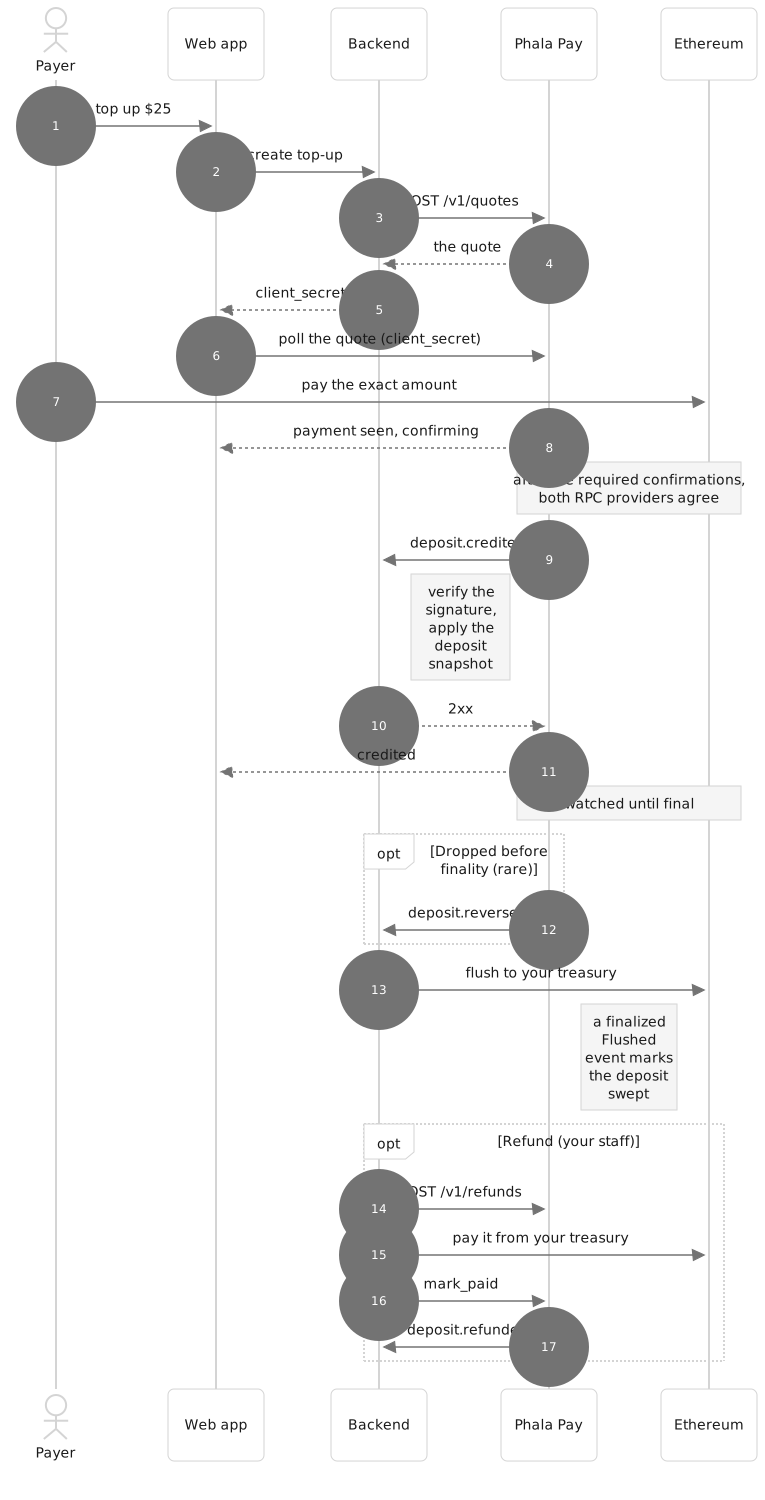
deposit address instead (§1.5). The service watches Ethereum for transfers to its addresses, waits for the
route's confirmation (two blocks on Ethereum), prices each deposit, and screens it. A deposit that
passes is credited, typically about 30 seconds after paying, and the service tells you
with a signed deposit.credited webhook. It keeps watching the deposit until it is final (about
15 minutes on Ethereum). In the rare case that a reorganization before then proves the payment
replaced (another transaction spent the payer's nonce, or another transfer holds its position at
finality), the deposit is reversed and a signed deposit.reversed, whose deposit nets to zero,
takes the credit back, as a refund's deposit.refunded takes back its share (§2.3). A payment
whose transaction leaves the chain with its nonce unspent is not reversed, since it could still be
included: the deposit stays credited and not final, counts against your cap on credit before
finality (§1.8), and the operator is alerted. You own the balance: you
verify the signature and credit the deposit once, the pattern of Stripe Checkout fulfillment
(docs.
1.2 Creating and showing a quote
Read GET /v1/config (pay.) for what the page shows instead of hardcoding. It
is your effective payment config: every asset your payment settings accept (§1.9) on a chain
where you have a treasury, each with your terms: the asset (chain, asset code, contract,
decimals), the minimum amount in cents (min_amount), the minimum and maximum deposit in token
units (min_, max_), the refund floor, the quote window, spread,
and tolerance, confirmations (the stricter of the chain's floor and yours: "2" on Ethereum
by default, the payment's block and one more; "3" on an OP-stack chain such as Base, the
payment's 2-second block and two more), the typical credit time (typical_, 30 on
Ethereum, 7 on Base), and the typical finality time (typical_, 900); and your
caps in the key's mode: open quotes (max_open_quotes), their credit in cents
(max_), one customer's (max_, which also
bounds one quote), and one customer's quotes per minute
(quote_). A quote of an asset your settings do not accept is
400 asset_. A quote keeps the terms it was issued with, shown in its terms,
whatever your settings say later. Quotes are priced at
spot / (1 + quote_spread_bps / 10 000); a payment valued at spot (late, wrong amount, second
payment) carries no spread; network and exchange fees are the payer's; sweep gas is yours, paid
when you sweep, and never reduces a credit.
What amount means. A deposit's amount in cents is a valuation: the USD value of the
tokens at the locked or spot price, which you credit to your customer. What you receive is the
tokens themselves, in forwarders that pay your treasury; Phala Pay converts nothing, so you carry
the token's price risk from the payment until you sell it.
POST /v1/quotes {client_ with an
Idempotency-Key returns the quote:
{ "id": "qt_0c6e1d0a9b3f4c2e8d7a6b5c4d3e2f10", "object": "quote", "livemode": false, "client_reference_id": "team-42", "treasury": "0x…", "amount": 2500, "currency": "usd", "chain_id": 11155111, "asset": "pha", "amount_atomic": "100502600000000000000", "exchange_rate": "0.24875621", "address": "0x…", "payment_uri": "ethereum:0x…@11155111/transfer?address=0x…&uint256=…", "status": "open", "expires_at": 1790410500, "created": 1790409600, "payment": null, "deposit": null, "client_secret": "qt_…_secret_…", "metadata": {"order_id": "6735"}}client_is your customer's id, such as your workspace id (1 to 200 characters, Stripe Checkout's name); the customer is created by its first quote or deposit address.reference_ id treasuryis the treasury the quote's address pays: your treasury of the chain when it was created (§1.6).amountis an integer in US cents;amount_atomicis the exact token amount to pay, a decimal string in base units, rounded up to four token decimals (the route'sasset.) so the payer reads and types a short amount such asquote_ amount_ decimals 100.5026 PHA; show every digit of it. The rounding is the payer's, below 0.0001 token, and the credit stays exactlyamount;exchange_rateis the locked price in USD per token with 8 decimal places; times are Unix seconds.statusisopen,complete(a matching payment consumed it),expired, orcanceled. A quote staysopenpastexpires_atuntil both endpoints cover its address beyond that time, so a payment mined in time is never reported as expired: hide the address onceexpires_athas passed and offer a new quote.paymentis what the waiting screen shows once a transfer is seen on chain, display only:status(seenonce in a block,recordedonce it is a deposit at the route's confirmation),chain_id,asset,tx_hash,amount_atomic,confirmationsandestimated_whilefinal_ at seen,matches_quote(credited at the quoted price when true), and thedep_id it has or will have. A seen payment can disappear in a reorg and is never a credit.depositis the deposit that completed the quote (expand[]=depositreturns it whole).metadataholds your own key/value pairs, such as your order id; the deposit that pays the quote starts with a copy (§1.4).GET /v1/quotes/{id}resumes a checkout;POST /v1/cancels an unpaid quote by settingquotes/ {id}/ cancel cancel_and ending its payment window. The response staysrequested_ at open; coverage later completes cancellation withquote.canceled. An in-window payment discovered afterwards consumes the quote normally. Hide the payment address after requesting cancellation.- A quote above the remaining open exposure fails with
400 exposure_; its message states what is left.cap_ exceeded
Validate the amount against /v1/config before creating the quote, and map a refused creation
(ApiError.code in Python) to a message the user can act on; never show the service's message
verbatim:
code |
Tell the user |
|---|---|
amount_ (400) |
The minimum top-up is min_. |
amount_ (400) |
The amount is above the maximum for one payment; split it. |
exposure_ (400) |
Too many unpaid quotes are open; pay or wait for one to expire, or enter a smaller amount. |
paused, chain_ (400) |
Crypto top-ups are temporarily unavailable. |
price_, unavailable, service_ (503), rate_, customer_ (429) |
Try again in a minute (Retry-After says how long). |
Fresh quote snapshots have a configured daily cap per price chain and environment
(default 60, production 150). Exhaustion returns retryable 503 price_; the
service never substitutes a stale price. Manual
transfers are discovered every 300 seconds; admitted checkout hints use the independent instant
processing path at route confirmation. Separate dual checkpoints run every 600 seconds, and
full dual coverage runs every 3,600 seconds with six-hour catch-up. With healthy endpoints,
caught-up addresses and work within pilot allowances, expiry/
Confirmation first probes only the required heads. Healthy Depth confirmation normally finishes about four seconds after the estimated depth, plus processing; temporary provider lag can wait up to the current normal interval (64 seconds at the end of the window). If only height remains insufficient after that window, a slow lane checks every minute for ten minutes, every ten minutes until six hours, then hourly. Recovery can take that interval plus processing; confirmation resumes as soon as both providers qualify, without waiting for the published checkpoint. Existing typical credit times describe healthy hinted payments and are not guarantees during provider lag.
Semantics (spread, tolerance, expiry by dual coverage time, exposure caps) are architecture §9.
Recompute every address before you show it. A quote's address salt is
keccak256(abi. with account your
acct_ id, and the address is the factory's CREATE2 clone of the implementation over your
pinned treasury of the quote's chain and that salt. Phala recomputes
every quote from those pins and raises Address when the quote names another
treasury, shows another address, or has no pinned treasury for its chain, so a user never pays an
address you did not derive. A Node
backend does the same with verify from @phala/, which
returns the address. Pass the recomputed address to the page as <Checkout expectedAddress>,
which fails closed on any other. You need no address records of your own to credit:
deposit.credited carries the deposit, which names the customer (client_) and the
quote (quote), also for a late or wrong-amount payment.
The payer's page. Hand the quote's client_secret to the paying customer's page only, and
do not log it. The page reads GET /v1/ without an API key, from any
origin, as Stripe.js reads a PaymentIntent: {id, object, livemode, status, amount, currency, asset, decimals, chain_id, amount_atomic, address, payment_uri, expires_at, payment_status, confirmations, amount_credited, typical_, where payment_status is none,
seen, confirming (at the route's confirmation, being valued and screened), credited,
rejected (contact support), or reversed (a reorganization before finality replaced the credited
payment). While credited, amount_credited is what the payment
credited in cents, the deposit's amount: it differs from amount for a payment valued at spot
(another amount, or paid late), so show it rather than the quote's. typical_ is
the typical time from paying to the credit at your account's confirmation for the chain, as
GET /v1/config reports it. It
carries no account, price, deposit id,
or transaction hash, and is rate-limited per quote. The secret is {quote id}_secret_ and 64
lowercase hex digits (a nonce and the service's tag of it); treat it as opaque. A malformed or
forged secret reads nothing (404). Only POST /v1/quotes returns the secret; a
repeat with the same Idempotency-Key within 24 hours returns the same response, secret included.
@phala/pay's <Checkout> is this page.
Resume a checkout. Keep the quote's client_secret in the browser (for example
localStorage, keyed by the signed-in account) until the checkout reaches credited, expired,
or canceled, or reports error. A payer who closes
the tab after paying then reopens the page on the same quote's progress instead of an empty form,
and does not pay twice.
Drive the page from the checkout. <Checkout onChange> is called once per status change with
{ status, quote, error }, like Stripe Elements' onChange. Hide your own "new payment" or
amount controls while the status is seen or confirming, so that a waiting payer does not
start a second payment. While waiting, tell the payer that the payment is credited in about the
quote's typical_ (30 seconds on Ethereum, about 7 seconds on Base, about 5 minutes
under a safe policy, 15 minutes at finalized), that they can close the page, and that the credit arrives
automatically. onSuccess(quote) is called once credited; quote. is what was
credited.
Theme it. Import "@phala/pay-react/styles.css" once in your application entry point.
Map your application's light/dark tokens to --pp-* properties on .pp-root[data-theme] in a
stylesheet loaded after the SDK's CSS, and omit appearance (pay-theme.css below):
import "@phala/pay-react/styles.css";import "./pay-theme.css";<Checkout clientSecret={clientSecret} expectedAddress={expectedAddress} apiBase={PHALA_PAY_API_BASE} onChange={({ status }) => setPaymentInFlight(status === "seen" || status === "confirming")} onSuccess={() => { forgetClientSecret(account.id); router.refresh(); }} onExpire={() => forgetClientSecret(account.id)}/>.pp-root[data-theme] { --pp-color-surface: var(--app-color-surface); --pp-color-text: var(--app-color-text); --pp-color-text-muted: var(--app-color-text-muted); --pp-color-border: var(--app-color-border); --pp-color-input: var(--app-color-input-border); --pp-color-primary: var(--app-color-primary); --pp-color-primary-foreground: var(--app-color-on-primary); --pp-color-selected: var(--app-color-selected); --pp-color-focus: var(--app-color-focus-ring); --pp-color-success: var(--app-color-success); --pp-color-warning: var(--app-color-warning-text); --pp-color-danger: var(--app-color-danger); --pp-font-size: 1em;}Without theme, defaults suit light backgrounds only; on dark hosts map every color variable.
A color you leave unmapped keeps its light default, so on a dark card the status row (the
surface) would be light-on-light. --pp- and --pp- color text, so map
them to text-safe tokens. A mapping written for an earlier SDK must use the current names:
--pp- is now --pp-, and an old name is silently ignored.
The components draw no frame or background: place them in your own card or dialog, and give it
inner padding of at least 4px so that the 2px focus outline is not clipped by its
overflow: hidden. They take your page's font; --pp-font-size: 1em also takes its text size.
--pp- draws the selected tab's underline and the checked choice's border, and
follows --pp- when you leave it unmapped. If your primary color is a light fill,
such as a lime button on a white card, map it to a color with 3:1 or more contrast against the
background (WCAG 1.4.11) and keep the light primary for the pay button. Map --pp-color-focus to
your focus ring color, distinct from the selected color, so that a keyboard user can tell the
focused choice from the selected one.
When you do not map your own tokens, appearance. selects the built-in neutral dark
palette.
See Appearance for every token and selector precedence.
1.3 Payment outcomes
A deposit's status is pending (recorded at the route's confirmation and being valued and
screened, or held while settlement or crediting of its treasury is paused, §1.6), then credited, or rejected with a
rejection_reason, or reversed (Stripe's status with booleans beside it). final turns true
once the deposit's block is final (about 15 minutes after paying on Ethereum; a final deposit can
no longer be reversed, and only a final one is refunded), and swept once a finalized sweep after
it moved its forwarder's balance to your treasury (§1.7). Nothing is reported as a deposit before
the route's confirmation (two blocks on Ethereum)
(architecture §7).
Phala's staging deposit driver asserts these outcomes on Sepolia
(deploy/phala.md, "Abnormal paths"); the sandbox scenarios assert them
locally (deploy/
| Payment | Outcome visible to you |
|---|---|
Exact quoted amount, in time (within quote_) |
Quote complete; deposit. with price_ and exactly the quoted amount. |
| Underpayment beyond tolerance | Credited at spot for what arrived; quote not completed and later quote.; cancel refused with 400 quote_. Payments are not accumulated against one quote: offer a new quote for the shortfall. |
| Overpayment beyond tolerance | Credited at spot for the full amount; quote not completed. |
After the window (mined after expires_) |
quote., then credited at spot (the deposit's quote still names the quote). A payment mined inside the window stays at the quoted price even if final later; the quote stays open past expires_ until then. |
| Second payment to a quote's address, or to a canceled quote's | Credited at spot. |
| Deposit address (§1.5), active or retired, an accepted token within its deposit limits on a listed network | Credited at spot when confirmed; the deposit has quote: null and names the deposit_, its chain_, and its address. |
| A routed token your payment settings do not accept (§1.9), on a chain or for an asset not configured, or anything while the account accepts nothing | rejected( once both providers confirm it, before it is valued; never credited; refundable once final, above the route's dust floor, like any rejected deposit (§3). The settings that decide are those current when the payment is recorded. A payment that completes a quote (its asset, in time, within its tolerance) is honoured at the quote's terms even if you stopped accepting the asset after issuing it. |
| Token without a route | Once final (about 15 minutes, up to one more reconciliation round), rejected(; never credited; the tokens stay in the forwarder. |
Below your min_ |
rejected(. |
Outside your min_..max_, or credit overflow |
rejected( or rejected(. |
| Sanctioned sender | rejected(; not refundable. |
| Known same-sender, same-nonce replacement agreed finalized by both endpoints, or its transfer is gone at finality | Deposit reversed; deposit. if you were told of it (credited or rejected): its amount_ takes the whole credit back (§2.3). A quote it completed always reopens with its reservation; coverage later expires or cancels it. A transaction re-included in another block keeps its deposit id and is not reversed. |
| A payment made through a contract (a router, a swap output) whose transaction is re-included before finality against other state, so that it pays you another amount, or another of your addresses | The first deposit is reversed as above, and the transfer now in the final chain is a new deposit with a new id, credited (or rejected) through the usual events, already final. The new deposit's replaces names the reversed one, and the reversed one's replaced_ names it (both null when the other deposit is in another account or mode). If it pays the same quote, it completes that quote in the first deposit's place, with no quote. in between. The events of the two deposits can arrive in any order (a new deposit's deposit. can even come before the old one's deposit.): apply each through the balance rule (§2.3), which nets the customer to what the final chain paid whatever the order. A plain transfer of a routed token cannot change this way: routes never take fee-on-transfer or rebasing tokens. |
| You refuse the credit (for example a closed customer) | Deposit credited; you hold it and refund it (§2.4). |
User-facing copy per state and reason, including what never to show, is in architecture §12, product UI.
1.4 Metadata
Quotes, deposits, and refunds carry metadata, as Stripe objects do
(docs.
- Set it on create:
metadataonPOST /v1/quotesandPOST /v1/refunds. A key set to""is left out. - Update it with
POST /v1/quotes/{id},POST /v1/, ordeposits/ {id} POST /v1/refunds/{id}{"metadata": {…}}, in any status. The update merges: a key with a value is set, a key set to""is unset, keys you do not send are kept, and{"metadata": ""}unsets every key. The 50-key limit applies to the result. - A deposit's metadata is initialized from its quote's (or its deposit address's, §1.5) when the
deposit is recorded, and is
independent afterwards: updating one does not change the other. This is how Stripe Checkout's
payment_sets the PaymentIntent's metadata, and how a PaymentIntent's metadata is copied to its Charge. So an order id set on the quote arrives in theintent_ data. metadata deposit.creditedwebhook'sdata., and a second payment to the same address carries it too.object. metadata - Reads with your API key and every webhook's
data.objectinclude it; the payer'sclient_secretview does not, as Stripe omits metadata from publishable-key reads. - A limit violation is
400 parameter_withinvalid paramnamingmetadata[key](the key, value, or type is invalid) ormetadata(too many keys, or not an object or""). metadatais part of the request anIdempotency-Keyidentifies (§5.6): the same key with other metadata is400 idempotency_.key_ reused
quote = pay.quotes.create(client_reference_id="team-42", amount=2500, chain_id=11155111, asset="pha", idempotency_key=order.id, metadata={"order_id": order.id})pay.deposits.update(deposit.id, metadata={"fulfilled_at": str(now)})pay.refunds.update(refund.id, metadata={"ticket": ""}) # unsets `ticket`1.5 Deposit addresses
A deposit address is the customer's own address, one address for all the tokens and networks
you accept (§1.9), like the stable bank-transfer details Stripe gives each customer
(customer balance funding instructions),
and like the one deposit address an exchange gives a user for every token and every EVM chain.
It never expires: the customer chooses an amount within the accepted token’s per-transfer
token bounds and meeting its minimum credit value, at any time, on any listed network.
Eligible transfers are credited at the market (spot) rate after confirmation,
within about 5 minutes plus the chain's confirmation (a transfer sent without a
transaction-hash hint waits for the 5-minute discovery scan), through
the same deposit.credited webhook as a quote payment.
Send only listed tokens: a token that is not listed is not credited.
| Use | When |
|---|---|
| A quote (§1.2) | The customer buys something of a known price and must see the exact token amount and the rate before paying. |
| A deposit address | Top-ups and balances: the amount is the customer's choice, they may pay repeatedly, or they pay from an exchange that cannot send an exact amount within a window. |
address = pay.deposit_addresses.create(client_reference_id="team-42", metadata={"team_id": "team-42"})# {"id": "da_…", "object": "deposit_address", "livemode": false, "client_reference_id": "team-42",# "address": "0xabc…", "version": 1, "salt": "0x…", "status": "active",# "created": 1790409600, "retired_at": null, "metadata": {"team_id": "team-42"},# "networks": [# {"chain_id": 11155111, "address": "0xabc…", "treasury": "0x…",# "assets": [{"asset": "pha", "contract": "0x…", "decimals": 18,# "min_amount": 500, "min_deposit_atomic": "100000000000000000",# "max_deposit_atomic": "10100000000000000000000",# "payment_uri": "ethereum:0x…@11155111/transfer?address=0xabc…"}]},# {"chain_id": 84532, "address": "0xabc…", "treasury": "0x…", "assets": [ … ]}]}POST /v1/returns the customer's active address with a newdeposit_ addresses {client_ reference_ id} client_secretfor the customer's page, issuing it the first time: call it whenever the page opens; the same request returns the same address until it is rotated, and it adds a network supported since. Addresses are per mode: a test key never sees a live address, andnetworkslists the chains of that mode.- One address, or one per network. The address is the same on every network only where the
forwarder factory is the same deployment (the same factory address and implementation, which the
deterministic deployment gives every supported chain) and your treasury is the same address (an
EOA, or a Safe deployed at the same address on each chain), on an EVM chain with the same
CREATE2rule; then the top-leveladdressis it. Where a network's treasury differs, that network's address differs, and the top-leveladdressisnull: show each network's ownnetworks[].then, never one address for all.address - Show only the networks in
networksand the tokens in theirassets: the networks and tokens your payment settings accept, read when the address is returned, so a change of your settings shows on the next read. Each asset carriesmin_amount, the minimum per-transfer credit in the account currency’s minor units (currently USD cents), andmin_anddeposit_ atomic max_, inclusive token bounds as decimal strings in atomic units. All three come from the account’s current payment settings and the route at view time, using the same resolver as screening and valuation. Both minima are independently enforced: a zero atomic minimum does not waive the credit minimum; smaller spot-valued transfers are rejected withdeposit_ atomic below_minimum. Merchant and client views always carry all three resolved fields. The adminPOST /v1/response omits all three (neveradmin/ restore/ deposit_ addresses nullor zero placeholders): reconstruction intentionally ignores payment settings while they are held. Divide token bounds by10 ** decimalsfor display without floating-point rounding. These are current terms, not a quote or a guarantee for a later transfer: screening uses the deposit’s bound settings revision and route version (§1.9). Eligible transfers meeting the credit minimum and token bounds are credited; transfers outside them are rejected and follow the existing refund rules (§1.3). Credit before finality also obeysmax_: a transfer past that cap waits for finality, so the typical credit time can be longer. A routed token you do not accept isunfinalized_ credit rejected(asset_, any other tokennot_ accepted) rejected (unsupported_, and neither is credited. Funds sent on a network that is not listed are not seen: they stay at the address on that chain and can be swept only once the forwarder factory is deployed there, and only if your treasury is the same address on that chain; contact the operator.asset) POST /v1/retires the address and returns the customer's next one, a new address on every network (for example after the address was exposed somewhere it should not be). A retired address is still credited; stop showing it, but never tell the customer a payment to it is lost. A customer rotates at most 10 times an hour (deposit_ addresses/ {id}/ rotate 429 customer_, withrate_ limit Retry-After), and rotating a retired address is400 deposit_.address_ retired metadata(§1.4) on the create request is merged into the returned address's;POST /v1/updates it on an active or retired address, a rotation carries it to the next address, and each deposit to the address starts with a copy, so it arrives indeposit_ addresses/ {id} {"metadata": {…}} deposit.creditedlike a quote's. The deposit names thedeposit_addressand thechain_idandaddressit arrived on.GET /v1/anddeposit_ addresses/ {id} GET /v1/read them;deposit_ addresses? client_ reference_ id= …& status= … GET /v1/lists what reached one.deposits? deposit_ address= da_ … paymentslists the address's payments of the last 24 hours, newest first, in a quote'spaymentshape:seenonce the service finds it (within about a block when the payment's hash was submitted, at the next discovery scan otherwise; with itsconfirmations), thenrecordedas a deposit, whichGET /v1/follows todeposits? deposit_ address= da_ … credited. Display only: credit fromdeposit.credited. The customer's page reads the same, without an API key, fromGET /v1/(deposit_ addresses/ {id}? client_ secret= … Client, any origin, rate-limited), with each payment's progress:Deposit Address seen,confirming,credited,rejected, orreversed, and each network'stypical_. Each create or rotation issues a new secret and the newest 10 stay valid, as a Stripe Customercredit_ seconds Session's; give it only to that customer's page and do not log it. - Recompute the address before showing it, as for quotes: the salt is
keccak256(abi.with the typesencode(account, livemode, client_ reference_ id, "deposit_ address", version)) (string, bool, string, string, uint256)(no chain, no asset), and each network's address is the factory'sCREATE2for that network'streasuryand the salt.Phalachecks every network of an active address over your pinned treasury of its chain and raisesPay(api_ key, pins=pins) Address(Mismatch Error verifyinDeposit Address(pins, address) @phala/);pay- server/ helpers topup_recomputes any version offline.sdk. deposit_ address(... ) - A network pays the treasury it was issued for, forever. When your treasury on one network
changes, that network's address changes (the others do not); payments to the old address on
that network are still credited and still reach the old treasury, and a refund of such a deposit
is paid from the old treasury, so keep control of it (you are told through
treasury.*events, §1.6). A network is issued only on a chain where you have a treasury. - Limits: 100 000 active addresses per account in live mode and 1 000 in test mode
(
400 deposit_; ask the operator to raise it); no new address is issued whileaddress_ cap_ exceeded quotesis paused (400 paused), and a network frozen by reconciliation gets no new address until it is lifted.
Page copy. "One address for all listed tokens and networks. Send only listed tokens." Let the
customer pick the network and the token; show that network, the token contract, the full address
with a copy button, and a QR of that token's payment_uri (it carries the token, chain, and address
and no amount). State the USD credit minimum and selected token’s maximum on its network, for
example: "Send at least $5.00 and up to 10,100 USDC per transfer on Base. Unsupported tokens or
networks are not credited. Eligible transfers are credited at the market rate, usually within about
5 minutes." If the atomic minimum is positive, state both independent floors: "Send at least $5.00
and 10 USDC, up to 10,100 USDC per transfer on Base." Omit the atomic minimum when it is zero;
the stricter floor at payment time binds. Group token amounts in English without losing precision.
Read all limits from the latest public view when available. When any limit is missing or malformed,
use "Send USDC on Base" without a range; never promise credit for any amount.
A payer sending from their own wallet or exchange gives the page no transaction hash,
so unless your page submits one (transaction-hash hints), each network's
time is the 5-minute discovery scan plus its typical_ in the address's public view
(above), the time from paying to credit at the confirmation your account's payments on that chain
wait for, as GET /v1/config reports it. Do not promise typical_ alone, which is
the time of a hinted payment: even a page that submits the hash can exhaust the daily hint budget
and fall back to the scan. Until the view is loaded the page names no time: "Eligible transfers are credited at the
market rate after confirmation."
<DepositAddress deposit from @phala/pay-react
renders exactly that from address and networks (pass only those and the client_secret to the
browser) and, with the secret, shows each payment as it arrives: "1.5 PHA received on Sepolia, 1
confirmation", then "credited".
Both React components pause polling in hidden tabs and read immediately on visibility regain,
with uniform ±20% jitter on their normal intervals and failure backoff, respecting Retry-After.
After ten minutes without a public-view change, DepositAddress uses an idle base interval of
max(poll milliseconds, so a longer configured interval stays unchanged;
any change or visibility regain resets that window and restores pollInterval (default 3000 ms).
Optional onChange(state) receives the Client view after the first successful read
and then once per content change, including confirmations and credit times. Unlike
<Checkout onChange>, it does not report loading. Use it to update your page without
additional polling; credit from your webhook. Checkout uses its existing error state after three
consecutive non-terminal 4xx responses other than 408/429; 404 still stops on the first response.
1.6 Treasuries
Your treasury is the only address your forwarders can pay: one per chain and mode, an EOA or a Safe deployed on that chain. You set it through the API with a signed EIP-4361 (Sign-In with Ethereum) message, which proves you control it and that it exists on the chain; the operator never sets it.
# 1. The message to sign, usable once: 10 minutes for an EOA, 24 hours for a Safe.curl -sS https://api.phala-pay.example/v1/treasuries/challenge -H "Authorization: Bearer $KEY" \ -H 'content-type: application/json' -d '{"chain_id": 11155111, "address": "0x…"}'# 2. Sign `message` exactly as returned, then submit it.curl -sS https://api.phala-pay.example/v1/treasuries -H "Authorization: Bearer $KEY" \ -H 'content-type: application/json' -d '{"chain_id": 11155111, "message": "…", "signature": "0x…"}'- EOA: sign with
personal_sign(EIP-191), for examplecast wallet sign "$MESSAGE";deploy/does both steps from a test key, and the Python SDK does them withsandbox/ set- treasury. sh pay.(installtreasuries. set_ eoa(chain_ id= …, address=…, private_key=…) phala-pay[eoa]); it refuses a key that is not the address's before anything is sent. - The address is screened for sanctions (
400 treasury_), again when a pending change is due to apply (a listed one issanctioned canceledwithcancellation_), and every day while it is your treasury: a listed treasury pauses your account'sreason: "sanctioned" quotesandsettlementuntil the operator reviews it with you. - When it applies. A chain's first treasury, and any test-mode change, apply at once. A later
live change is
pendingfor 48 hours, then applies;treasury.createdtells every enabled webhook endpoint of the mode at once, whatever events it subscribes to, so a leaked key cannot redirect payments unseen: cancel an unrequested change withPOST /v1/and roll your keys (§5.4). One change waits per chain (treasuries/ {id}/ cancel 400 treasury_).change_ pending - What changes. New quotes, and the chain's network of each of your deposit addresses (§1.5),
pay the new treasury; each quote shows the
treasuryits address pays. Everything issued before keeps paying the old treasury for good (the address commits to it): those payments are still credited, and their refunds are paid from the old treasury (§3), so keep control of it. Update the treasury you pin in your server (Quickstart) when the change applies (treasury.updated): until then your pins refuse the new treasury's addresses, and after it the old one's. - Pause crediting of a treasury. If a treasury is compromised (for example a former
treasury's key leaked),
POST /v1/(treasuries/ {id}/ pause pay., a secret key) stops crediting every deposit to the forwarders over that treasury's address: new payments there staytreasuries. pause(id) pendingand nodeposit.creditedis sent, so you do not credit customers for funds that a thief can sweep; deposits already credited are unchanged.POST /v1/credits what it held. The operator can pause a treasury too, in an incident; your resume does not lift the operator's pause (treasuries/ {id}/ resume crediting_lists both). Each change ispaused_ by treasury.updated(runbook).
Safe treasuries. The Safe must be deployed on the chain, at its finalized block (about 15
minutes on Ethereum): a counterfactual Safe is refused (treasury_), and so are
ERC-6492 signatures. The service calls the Safe's EIP-1271 isValid with hash the message's EIP-191 hash, on two RPC providers at finalized, and
requires 0x1626ba7e. On a Safe (v1.3.0 and later, with the default Compatibilityhash itself: the handler wraps it in the
EIP-712 Safe of the Safe's domain {chainId, verifying,
with message = hash, and checks the owners' signatures of that, as the Safe executes a
transaction. So the owners never personal_sign the challenge (that is refused); they sign it as a
Safe message, which is what Safe{Core} SDK's Protocol Kit does for a string message
(Safe docs, message signatures;
Compatibility v1.4.1;
Protocol Kit generate):
import Safe, { hashSafeMessage, SigningMethod } from '@safe-global/protocol-kit'const challenge = await createChallenge({ chain_id, address: SAFE_ADDRESS }) // POST /v1/treasuries/challengelet protocolKit = await Safe.init({ provider: RPC_URL, signer: OWNER_1_KEY, safeAddress: SAFE_ADDRESS })let safeMessage = protocolKit.createMessage(challenge.message) // the EIP-4361 text, unchangedsafeMessage = await protocolKit.signMessage(safeMessage, SigningMethod.ETH_SIGN_TYPED_DATA_V4)// Up to the threshold, each further owner signs the same object:protocolKit = await protocolKit.connect({ provider: RPC_URL, signer: OWNER_2_KEY })safeMessage = await protocolKit.signMessage(safeMessage, SigningMethod.ETH_SIGN_TYPED_DATA_V4)const signature = safeMessage.encodedSignatures() // 65 bytes per owner, in ascending owner order// Optional: the same check the service makes (at the latest block instead of `finalized`).await protocolKit.isValidSignature(hashSafeMessage(challenge.message), signature) // trueawait submitTreasury({ chain_id, message: challenge.message, signature }) // POST /v1/treasuries- Owners in different places. One owner proposes the message to the Safe Transaction Service
with API Kit,
api; the others add theirs withKit. add Message(SAFE_ ADDRESS, {message: challenge. message, signature: build Signature Bytes([own Signature])}) api, whereKit. add Message Signature(safe Message Hash, …) safeMessageHash = await protocol; Safe{Wallet} lists the message atKit. get Safe Message Hash(hash Safe Message(challenge. message)) https://. Once the threshold is reached,app. safe. global/ transactions/ messages? safe= <prefix>: <Safe> (await apiis the signature to submit. A Safe's challenge lasts 24 hours for this.Kit. get Message(safe Message Hash)). prepared Signature - On chain instead. A Safe transaction, executed by the owners like any other, with
operation: DelegateCallto the Safe'sSignMessageLib, callingsign, records the approval in the Safe; submitMessage(hash Safe Message(challenge. message)) "signature": "0x"once that transaction is atfinalized, within the challenge's 24 hours. - Submit the collected signature with the Python SDK as for an EOA:
challenge = pay., the owners signtreasuries. challenge(chain_ id= …, address=SAFE) challenge.as above, thenmessage pay..treasuries. create(chain_ id= …, message= challenge. message, signature= signature) - The service's tests run exactly these three flows (1-of-1, 2-of-3, and
SignMessageLib) against Safe v1.4.1 built fromsafe-global/safe-at tag v1.4.1, whose code equals the canonical deployment's, and refuse a non-owner's signature, too few signatures, and an owner'ssmart- account personal_signof the message.
1.7 Balance, sweeps, and the forwarder export
Payments wait in their forwarders until you sweep them to your treasury: nothing Phala runs can
move them, and a forwarder can pay only the treasury in its address. You choose when, and pay the
gas, with one factory. per token and treasury (design D4).
GET /v1/balance(pay., Stripe's Balance): per chain and token, thebalance. retrieve() amount_atomicyour forwarders hold (deposits not reversed, minus finalized sweeps) and thefinal_part of it from final deposits, which is safe to sweep.amount_ atomic GET /v1/forwarders(pay.): every forwarder issued in the mode, for quotes and for deposit address networks (current and superseded,forwarders. list() superseded_at), with itschain_id,address,factory,salt, andtreasury: the export that keeps your funds recomputable and sweepable even without Phala Pay. Withsweepable=it lists only forwarders with a final unswept balance of that token that may be swept: never one holding a deposit rejected as<token> sanctioned, and never one paying a treasury a sanctions list names (503when screening cannot answer).GET /v1/sweeps(pay., Stripe's Payouts): every finalizedsweeps. list() Flushedevent of your forwarders, whoever sent the flush, assw_…objects with the forwarder, token, treasury, amount, and transaction. A deposit issweptonce a sweep after it moved its forwarder's balance.
The call is built offline, from the forwarders, by the SDKs:
from topup_sdk import flush_transactions, safe_batch, write_safe_batchforwarders = list(pay.forwarders.list(chain_id=1, sweepable=PHA))calls = flush_transactions(forwarders, PHA) # one {to, data, value} per treasury, 200 each# An EOA treasury, or any wallet: send each call as an ordinary transaction.# A Safe treasury: write a Transaction Builder batch for the owners.write_safe_batch("sweep.json", safe_batch(1, SAFE, calls, name="Phala Pay sweep 2026-10"))The batch file is the Safe{Wallet} Transaction Builder's BatchFile
(models.ts),
with the app's own meta.checksum, so it imports without a "modified" warning. An owner opens
Safe{Wallet} > Apps > Transaction Builder, drags the file in, and creates the batch; the owners
sign and execute it as any Safe transaction
(Safe help).
@phala/ has the same flush and safeBatch for a Node backend.
pay. writes every list, forwarders.json included, to JSON files.
1.8 Confirmations and pausing
- A stricter confirmation. A chain's
confirmationsin your payment settings (§1.9), such asPOST /v1/, credits that chain's payments only at the stricter of the chain's floor and your value: a depth such aspayment_ settings {"chains": [{"chain_id": 1, "confirmations": "finalized", "assets": [{"asset": "pha"}]}]} "12","safe"(OP-stack chains only), or"finalized", never weaker than the floor (400otherwise). From weaker to stricter: a depth, a deeper depth,"safe","finalized". On an OP-stack chain such as Base, the floor's depth counts blocks on the sequencer's unsafe head, which Base reports reorganized only once ever;"safe"waits, about 5 minutes, until the block is derived from data posted to Ethereum, which the sequencer cannot rewrite on its own, and"finalized"until that data is final.nullkeeps the floor. A payment waits for the requirement of the settings it is bound to (those current when it was recorded, or its quote's) or the operator's current floor, whichever is stricter: a change applies to payments recorded after it, so to hold payments already recorded, pause crediting of the treasury (§1.6).GET /v1/configreports each chain'sconfirmationsandtypical_. If you sell goods or services you cannot take back (withdrawable balances, gift cards, anything delivered off platform), usecredit_ seconds finalized: a credit before finality can still be reversed by a reorganization, and a reversal is recoverable only by clawing the credit back (§2.3); a deposit waitspendinguntil final meanwhile. - The cap on credit before finality. However you configure confirmations, the credit of your
deposits credited but not final yet is capped per mode: $1 000 by default
(
max_, 100 000 cents), which the operator raises or lowers for your account on request. A deposit whose credit would take that total past the cap is not rejected: it staysunfinalized_ credit pendingand is credited as soon as it is final (about 15 minutes on Ethereum), or earlier once other deposits become final and make room. Plan for it in your UI's waiting state (§1.3). - Pause issuing.
POST /v1/(account/ pause {"scopes": ["quotes"]} pay.) stops new quotes, deposit addresses, and networks in both modes, for an emergency such as a leaked key during a treasury time-lock; payments to existing addresses keep being credited.account. pause_ quotes() POST /v1/lifts your own pause; a pause the operator set stays inaccount/ resume paused_scopesuntil the operator lifts it. Both are announced asaccount.updated.
1.9 Payment settings
Your payment settings say what you accept and on what terms, per mode, like Stripe's
payment method configurations: the
chains and assets you take, a stricter confirmation per chain, and your terms on each asset,
chosen from your operator's routes within the bounds the operator sets. A new account accepts
nothing: quotes and deposit addresses answer 400 asset_, and a payment to an
address is rejected(asset_, until you configure the mode. Manage them with the
secret key; a restricted key can read them (account.read) but not change them (§5.4).
settings = pay.payment_settings.update(chains=[ {"chain_id": 11155111, "assets": [{"asset": "usdc"}, {"asset": "usdt"}]}, {"chain_id": 84532, "confirmations": "safe", "assets": [{"asset": "usdc", "quote_spread_bps": 0, "min_amount": 500}]},])# GET /v1/payment_settings: {"object": "payment_settings", "livemode": false,# "status": "configured", "revision": "psrev_…", "updated": 1790409600,# "quote_creations_per_customer_per_minute": null, "chains": [ … as sent … ],# "available": [{"chain_id": 11155111, "status": "active",# "confirmations": {"floor": "2", "default": "2"},# "assets": [{"asset": "usdc", "accepted": true, "enabled": true,# "quote_spread_bps": {"default": 0, "min": 0, "max": 500}, …}, …]}]}- What you can set. Per chain,
confirmations(stricter than the floor, §1.8). Per asset:quote_,ttl_ seconds quote_spread_bps,quote_(two-sided: a payment within it of the quoted amount, under or over, completes the quote at itstolerance_ bps amount),min_amount(cents),min_,deposit_ atomic max_, anddeposit_ atomic min_. Top-level:refund_ atomic quote_(1 to 60). A term not sent, orcreations_ per_ customer_ per_ minute null, takes the operator's default, so you follow a change of it.availablelists every chain and asset of the mode with its defaults and bounds; a value outside them is400 parameter_with the exactinvalid parampath and the bounds. The rounding of a quote's amount (quote_) is the operator's.amount_ decimals - Updates. A parameter not sent is unchanged.
chains, when sent, replaces the whole list, and a term an element leaves out resets to the default;"chains": []accepts nothing. Writes are last-write-wins: two concurrent updates apply one after the other, and the later one is current. Each change has a newrevisionand is announced aspayment_withsettings. updated previous_, delivered to every endpoint whatever it subscribes to.attributes - Active chains. A chain is offered only where you also have a treasury (
available[].status active;treasury_not_setuntil you set one, §1.6). - Which settings govern a payment. A quote keeps the terms it was issued with; a payment that completes it (its asset, in time, within its tolerance) is credited on them even after you stop accepting the asset. Every other payment is governed by the settings current when it is recorded: a change applies to payments recorded after it, never to one recorded before.
- Disabled pairs. If the operator tightens a bound so that your terms on an asset no longer
fit together (for example a maximum deposit below your minimum), that asset is
enabled: false: not offered or credited until you or the operator change it. - After a service restore your settings are
helduntil you reconfirm them (§5.12).
Transaction-hash hints
@phala/pay submits a hint automatically when payWithWallet returns the broadcast hash for
a quote retrieved by its client. <Checkout> needs no integration change. The hint starts
receipt polling immediately; manual transfers still use the normal scanner.
For a custom wallet flow, submit the returned hash yourself:
await pay.submitTransaction(clientSecret, transactionHash);// For a deposit-address client secret, also select an issued network:await pay.submitTransaction(addressClientSecret, transactionHash, { chainId: 84532 });Server forwarding uses the merchant key:
await pay.quotes.submitTransaction(quoteId, { transaction_hash: transactionHash });await pay.depositAddresses.submitTransaction(addressId, { transaction_hash: transactionHash, chain_id: 84532,});Python exposes the same operations:
pay.quotes.submit_transaction(quote_id, transaction_hash=transaction_hash)pay.deposit_addresses.submit_transaction( address_id, transaction_hash=transaction_hash, chain_id=84532)Plain HTTP accepts POST /v1/ with {"transaction_ and
POST /v1/ with
{"transaction_. Browser calls authenticate with the object's
client_secret query parameter; server calls require quotes.write or
deposit_. A quote uses its stored chain, a deposit address requires one of
its issued networks, and the server derives the recipient. Extra body fields do not select an
address or change payment terms.
Every submission responds 202 with
{"object":.
This acknowledges receipt only. Unknown objects, invalid credentials, unrelated or unmined
transactions, duplicates and exhausted limits give no payment signal. Continue polling the quote
or deposit address and fulfill only from verified webhooks.
Hints can record only a successful routed ERC-20 transfer agreed by both RPC endpoints at the
route's confirmation. The worker first polls read for inclusion and confirmation depth, then
polls verify's head and fetches complete independent evidence on each endpoint. Lagging
receipt visibility keeps polling within the task budget; only confirmed evidence disagreement
raises an alert. They do not advance coverage or cause expiry, cancellation, rejection or
credit by themselves. Each task is limited to 12 read calls and 8 verify calls including retries
and head polling, and 90 seconds on Ethereum chains or 30 seconds on Base chains. Limits are
3/minute and 10/day per authenticated object, four active tasks, and a per-environment daily
task cap set by the operator (hints_per_day, default 80; Phala's production uses 200). Hint endpoints have no per-IP limit; see the operator
API admission limits for the ingress protection model.
Transfers before the address's created_block are ignored, as in coverage scanning.
Browser preflight returns an empty 204 with Access-.
A not-ready endpoint parks hints in a bounded process-local queue
for at most 15 minutes. Exhausted, dropped or interrupted hints leave detection to the scanner;
wallet submission errors never change an already broadcast payment's result.
2. Webhooks and fulfillment
2.1 The event
deposit.credited is the one event that moves a balance. The service writes it when a deposit
passes screening, in the same transaction that marks the deposit credited: the credit is owed
to you whatever you answer, until a deposit.reversed takes it back (§2.3).
POST {your webhook endpoint's url}content-type: application/jsonwebhook-id: evt_26a20351ab10595a852f9c1aa0372d73webhook-timestamp: 1790409600webhook-signature: v1a,<base64 ed25519 over "{webhook-id}.{webhook-timestamp}.{raw body}">{"id": "evt_26a20351ab10595a852f9c1aa0372d73", "object": "event", "type": "deposit.credited", "created": 1790409590, "data": {"object": {"id": "dep_3f1c2b9e6a8d5c479e210b7d4f6a8c13", "object": "deposit", "client_reference_id": "team-42", "quote": "qt_…", "status": "credited", "amount": 1234, "currency": "usd", "price_source": "quote", "metadata": {"order_id": "6735"}, …}}}data.objectis the deposit asGET /v1/returned it when it was credited: a snapshot rendered in the transaction that credits it and never changed afterwards (Stripe). Itsdeposits/ {id} statusiscredited; a later sweep, refund, or reversal does not change it, but sends its owndeposit.*event with a new snapshot: fetch the deposit for its current state.amountis the credit in cents: exactly the quote'samountwhenprice_sourceisquote, otherwise spot when the deposit is confirmed (§1.3).quoteis the quote of the receiving address, also when a late or wrong-amount payment was valued at spot; it isnullfor a deposit address's payment, which names itsdeposit_addressinstead.metadatais the deposit's, which starts as a copy of the quote's (§1.4). As the rest ofdata.object, it is what the deposit held when it was credited.webhook-idis the event'sid:evt_and the hex ofuuid_(v5(DEPOSIT_ NAMESPACE, "deposit. credited: " + deposit UUID) topup_), so every retry, resend, and re-emission after a service restore carries the same id.sdk. credited_ event_ id
2.2 The fulfillment function
from topup_sdk import SignatureError, verify_webhookRANK = {"pending": 0, "credited": 1, "rejected": 1, "reversed": 2}def handle_webhook(headers: dict[str, str], raw_body: bytes) -> int: try: # Pinned keys (§5.3); fails closed for another account or mode; 300 s tolerance. event = verify_webhook( headers, raw_body, WEBHOOK_KEYS, expected_account=ACCOUNT, expected_livemode=False ) except SignatureError: return 400 with db.transaction(): if inbox.contains(event.id): # a redelivery: the first is kept and applied already return 204 if event.type.startswith("deposit."): apply_deposit(event.data["object"]) # every deposit.* event, the balance rule (§2.3) # The delivery as received, for history and for a service restore (§5.12): the raw body # bytes and the webhook-id, webhook-timestamp, and webhook-signature headers. inbox.insert(event.id, event.type, raw_body, headers) return 204 # only after the commitdef apply_deposit(snapshot: dict) -> None: view = deposits.lock_or_insert(snapshot["id"]) # "dep_…", unique; one delivery at a time if view.held or (view.new and refuses(snapshot)): # unknown, closed, or suspended customer view.hold() # never applied; support later refunds it (§2.4) return if RANK[snapshot["status"]] > RANK[view.status]: view.status = snapshot["status"] view.amount = view.amount or snapshot["amount"] or 0 view.refunded = max(view.refunded, snapshot["amount_refunded"]) view.reversed = max(view.reversed, snapshot["amount_reversed"]) nets = (view.amount - view.refunded - view.reversed if view.status in ("credited", "reversed") else 0) ledger.credit(snapshot["client_reference_id"], nets - view.applied) # the change only view.applied = netsphala_pay's webhooks. (Quickstart) is the same verification with a typed
event. sdk/apply_deposit) is this in
full on SQLite; deploy/amount follows only a service restore: keep the first amount and report it (obligation 5).
2.3 Obligations
| # | Obligation | Why |
|---|---|---|
| 1 | Verify the v1a signature over the raw body against your account's pinned key for the mode, and that the event's account and livemode are yours; answer 400 otherwise. |
Only the attested service may credit, and only your own account's events: a key is per account and mode, so another merchant cannot replay its events to you. |
| 2 | Credit at most once per deposit id (dep_): the credit and its record in one transaction under a unique index; concurrent deliveries credit once. |
Delivery is at least once and may be concurrent. |
| 3 | Answer 2xx only after that commit, and quickly (the service waits 20 s); do slow work (emails) from a queue. |
Anything else is retried, with full-jitter backoff up to 1 h, forever. |
| 4 | Refuse by holding (§2.4), never by failing the delivery. | A refused credit answered 5xx is retried forever. |
| 5 | On a repeat with a different amount, keep the first credit and report it to the operator. |
Only a service restored from backup re-prices a spot deposit, and only one whose delivery you did not give the operator (architecture §14); the deliveries you give the operator after a restore are kept as delivered, their credit stands, and they are not sent again (§5.12). |
| 6 | Keep each delivery as your receiver got it, once per webhook-id: the raw body bytes and the webhook-id, webhook-timestamp, and webhook-signature headers, in the same transaction as its credit. |
After a service restore only a delivery the service signed can be imported, so a parsed or re-serialized event cannot prove the credit you were told of (§5.12). |
| 6 | Apply deposit. and deposit. by the balance rule below, from the snapshot, per deposit, serially (a held credit was never applied, so nothing is taken back from it). |
A credit is made about 30 seconds after paying, before finality; a reorg that drops the payment's transaction is rare and recoverable only this way. A partial refund takes back its share of the credit. |
The balance rule and event ordering
Every deposit.* event (deposit.credited, deposit.refunded, deposit.reversed,
deposit.rejected) carries the whole deposit with cumulative amounts the service computes, so
you never derive a claw-back yourself:
amount: the credit in cents.amount_refunded: the cents ofamountits succeeded refunds take back, pro rata to the refunded tokens (amount × amount_), rounded down so it never exceeds the refunded share, and all ofrefunded_ atomic / amount_atomic amountonce fully refunded. Computed from the cumulative refunded amount, it only grows.amount_reversed: all ofamountonce the deposit isreversed, else 0. Only a final deposit is refunded and a final deposit is never reversed, so a deposit has one or the other.
A deposit nets to amount − amount_refunded − amount_reversed cents while its status is
credited or reversed, and to 0 while it is pending or rejected. Keep, per deposit, the
latest view you applied and what it netted to; on each event, in one transaction that locks the
deposit's row (so deliveries of one deposit apply one at a time):
- Merge the snapshot into your view: the later
statuswins (pending, thencreditedorrejected, thenreversed; a status never moves back), and the largeramount_refundedandamount_reversedwin (they never decrease). - Compute what the merged view nets to, and move the customer's balance by the difference from what the deposit netted to before; store both.
Events may arrive in any order, late, or repeated, and each delivery is retried independently, so
never act on the event type or on arrival order: the merge makes the result the same whatever the
order, and a repeat changes nothing. A deposit.reversed that arrives before deposit.credited
leaves the deposit netting to 0, and the late credit then changes nothing; a deposit.refunded
that arrives first applies its claw-back together with the credit. Event created times order a
deposit's events for display, but the merge, not created, decides the balance.
sdk/apply_deposit) and the reference
product (deploy/
Optional hardening, your choice: fetch GET /v1/ in fulfill and require
status: "credited" with the same amount; recompute the deposit id, dep_ and the hex of
uuid_v5(NS, "{chain_ (topup_), where
receipt_ is the transfer's position among its transaction's receipt logs (0 for a plain
token transfer), and verify the cited log on your own node at finality (a deposit with replaces
set has another id: verify its log alone, §1.3); per-deposit and per-period caps as review holds. None is needed for
correctness: as with a card processor, the credit is authorized by the service's signature.
Do not credit from a checkout page's own fetch of the deposit: credits come only from signed
events, and the event follows the credited commit within a second.
Promotions are your own logic
Phala Pay reports each deposit's exact USD value and nothing else: a bonus, a discount, or any
other incentive is your product's decision, applied in your own fulfillment. Phala Pay has no
promotion setting. A pattern that stays correct under the balance rule: fix the rate when you
credit (on the order, so ending a promotion changes no earlier deposit), keep the bonus as a
ledger line of its own beside the credit, and bring it, on every deposit.* event and in the same
transaction, to its share of what the deposit nets to:
bonus_target = nets_to * bonus_bps // 10_000 # cents, rounded down; nets_to as abovechange = bonus_target - bonus_so_far # one ledger line when non-zeroA partial refund then takes back its share of the bonus, a full refund or a reversal all of it,
and a repeated or reordered event changes nothing, so refunding or reversing never leaves a bonus
behind. The staging reference product's +10% on credits paid in PHA is this pattern
(fulfillment.py, bonus_bps in its config);
the live demo on pay.phala.com shows it as a demo merchant's promotion.
2.4 Refusing a credit
The service never asks whether you accept a deposit. To refuse one (a customer you do not know, a
closed or suspended customer, your own caps), record it as held and answer 2xx; once the final
deposit is refundable and support has a destination address from the payer, your staff refund it
from your internal admin (§3): you pay it from your treasury, attach the transaction, and
deposit.refunded follows. To stop issuing new addresses, pause your quotes (§1.8); to hold
crediting of one compromised treasury's forwarders, pause its crediting (§1.6). Holding one
customer's crediting (settlement) is an operator action, for an incident: ask the operator.
2.5 Phala Cloud ledger mapping
Phala Cloud's backend, as an example of a ledger: find-or-create an Order (provider = crypto_topup, order_flow_code = 'crypto-top-up',
provider_ = the deposit id dep_…, unique per flow), the credit transaction with
funding_source = crypto:, and complete_, in one transaction
(architecture §11).
2.6 Delivery and event types
Every event, deposit.credited included, is Standard Webhooks with the asymmetric v1a scheme,
signed with your account's key in the event's mode and POSTed to each enabled webhook endpoint of
your account in that mode that subscribes to its type (§5.11):
webhook-id: evt_…webhook-timestamp: <Unix seconds of this attempt>webhook-signature: v1a,<base64 ed25519 over "{webhook-id}.{webhook-timestamp}.{raw body}"> (one space-separated entry per key while a rotation overlaps, §5.3){"id": "<same evt_ id>", "object": "event", "account": "acct_…", "livemode": false, "type": "deposit.credited", "created": 1790409590, "actor": "system", "request": null, "data": {"object": {…}}}The body is Stripe's Event object; the signature is
Standard Webhooks, not Stripe-Signature, because you hold only the service's public key.
-
data.objectis the object as it was when the event happened, rendered in the same transaction as the change and never re-rendered: every endpoint, retry, resend, andGET /v1/eventsread gets the same body, and a later change of the object does not alter it. Fetch the object for its current state. -
*.updatedevents adddata.: the fields that changed, with their values before the change (a changedprevious_ attributes metadataholds only its changed keys; a field that was added isnull). -
requestis the API request that caused the event:id, the response'sRequest-Id, andidempotency_key, theIdempotency-Keyit sent;nullwhen the service's own workers caused it (a payment credited, a quote expired, a time-locked treasury applied).actornames who: the key id (key_…),adminfor the operator, orsystem. -
Verify over the raw body bytes, never re-serialized JSON. Several space-separated signatures may appear during a key rotation; accept when one verifies.
-
Answer
2xxonly after the credit and the event are durably stored. Anything else, a redirect (never followed), or no answer within 20 s is retried with full-jitter backoff whose ceiling starts at 30 s and doubles to 1 h, until delivered; a429or503withRetry-After(seconds or an HTTP date) waits at least that long, up to 1 h. An endpoint is never disabled for failing, so a credit is never dropped. While your endpoint keeps failing it is probed about once an hour, one event at a time; once it answers2xxits backlog is delivered. Answer410 Goneonly to stop deliveries for good: it disables the endpoint at once (disabled_reason: "gone") and your other endpoints getwebhook_. Every event stays inendpoint. updated GET /v1/events; resend any with §5.11. -
Deduplicate by
webhook-id; delivery is at least once. -
There is no ordering:
quote.expiredcan arrive after thedeposit.creditedof a late payment, and adeposit.reversedbefore thedeposit.creditedof the same deposit. Act on the snapshot or fetched state (the deposit or quote), never on event order. -
Only
deposit.*events move a balance, by the balance rule (§2.3): the deposit'samount − amount_refunded − amount_reversed; every other event is for notifications, history, and UI refresh. -
Ignore unknown event types and unknown fields.
-
Resend a lost event yourself with
POST /v1/: same id, same body (§5.11). The operator does not manage your endpoints or resend your events.events/ {id}/ resend {webhook_ endpoint}
| Type | When | data. |
|---|---|---|
deposit. |
At the route's confirmation, priced and screened: fulfill it (§2). | The deposit |
deposit. |
Rejected (§1.3); rejection_ says why. |
The deposit |
deposit. |
The deposit's transaction left the chain before finality; sent if you were told of the deposit (credited or rejected). Its amount_ takes its credit back (§2.3). |
The deposit, status: "reversed" |
deposit. |
A refund transaction is final; one event per refund. | The deposit, with its cumulative amount_ and amount_ |
refund. |
A refund was requested (POST /, §3). |
The refund, status: "pending" |
refund. |
A refund changed: marked paid, canceled (by you before mark_), succeeded or failed, or its metadata; data. names what changed. |
The refund |
refund. |
Both providers agree that the finalized transaction attached with mark_ does not pay the refund (§3); one event per failed refund, beside its refund.. Create a new refund only after it fails. Missing or dropped transactions stay pending and reserved; never seen by either provider for 24 h alerts the operator. |
The refund, status: "failed" with its failure_ |
quote. |
Dual coverage completed a requested cancellation; payments outside its shortened window are credited at spot. | The quote, status: "canceled" |
quote. |
The finalized chain passed expires_ with the quote unpaid. |
The quote |
treasury. |
A treasury was proven (§1.6): active at once for a chain's first one and in test mode, else pending until effective_. Cancel a change you did not request. |
The treasury |
treasury. |
A pending treasury took effect (status: "active"), a newer one replaced it (status: "replaced"), or crediting of it was paused or resumed (crediting_, crediting_); data. has the former values. |
The treasury |
treasury. |
A pending change was canceled, by you or because a sanctions list named it at its effective time. | The treasury, status: "canceled" |
account. |
The operator changed your account (live mode, restriction, pauses), or your pause or webhook keys changed; data. names what changed. |
The account, in the event's mode |
payment_ |
Your payment settings in the mode changed or were reconfirmed (§1.9); data. names what changed. |
The payment settings, in the event's mode |
api_, api_, api_ |
A key of the mode was created, rolled (updated, with its former status and expires_), or revoked (§5.4). |
The key, without its secret |
webhook_, webhook_, webhook_ |
An endpoint of the mode changed; updated carries the replaced values in data. (§5.11). |
The endpoint, as it was after the change |
webhook_ |
POST /; sent to that endpoint only. |
The endpoint |
The account events (account.*, api_key.*, payment_, treasury.*,
webhook_) are your security notices: every enabled endpoint of the mode receives them whatever its enabled_events.
Delivery health
Deliveries are retried until delivered, so a failing endpoint shows as a backlog, never as a
disabled endpoint. GET /v1/ (and the list) reports, for each endpoint,
pending_ (not delivered yet), oldest_ (creation time of the oldest event
it has not received), and last_attempt (at, and the status_code it answered, null for a
timeout or refused connection). A growing pending_ or an old oldest_
means the endpoint is failing: fix it, and its backlog is delivered at its next probe (within an
hour). GET /v1/ lists every event some endpoint has not received
(Stripe's delivery_success); resend any with
POST /v1/. Since there is no dashboard or email channel, poll these from your
monitoring. The operator's daily report also lists endpoints failing for more than a day, and the
operator may contact you about one.
Every deposit and quote names its client_. Before the route's confirmation nothing
is sent: a page shows the payment from the quote's payment or the deposit address's payments
(or the payer's view read by client_secret).
2.7 Receipts
Recommended if you already bill with Stripe, and not required: record each credited deposit in Stripe, so the customer gets the same invoice and receipt as for a card top-up.
- On
deposit.credited, after the credit commits, create an invoice for the customer with one line ofamountcents, finalize it, and mark it paid withInvoice.: no charge is made. Make the line's price tax-inclusive (pay(paid_ out_ of_ band= True) tax_behavior: "inclusive"), so the invoice total equals the credited amount. - Do it once per
dep_id. Store the invoice id against the deposit right after creating it, and resume from the stored id (finalize, then pay) instead of creating another. Stripe idempotency keys alone are not enough: Stripe keeps them 24 hours, and a retry can come later. - When a deposit's
amount_refundedoramount_reversedgrows (§2.3), issue a credit note on that invoice without_for the growth, once per change.of_ band_ amount - Do this from a queue, not inside the webhook's
2xxpath: a Stripe outage must not hold a credit (§2.3, obligation 3).
3. Refunds
A rejected deposit is refundable unless the reason is sanctioned or its amount is below the
route's min_ (in /v1/config). A credited deposit is refunded only when you ask,
for a credit you did not apply or reverse, such as a held credit (§2.4;
architecture §15).
The service never moves funds: you pay every refund from your own treasury, in two steps, as
BTCPay Server's payouts do (BTCPay payouts). Refunds are
staff actions, as in Stripe's Dashboard: your support or finance staff start one
from your own internal admin, whose backend holds your secret key. Never offer a refund
as a self-service action to the paying user: a crypto refund is irreversible, and a credited
balance may already be spent. Request it by deposit id, not through the user's account, so that a
payment to an account that no longer exists (a deleted workspace, a mistyped id) is refundable
too. Ask the user for a destination address they control (never default to from_address,
which may be an exchange), then:
POST /v1/refundsIdempotency-Key: "…"{"deposit": "dep_…", "destination_address": "0x…", "amount_atomic": "…", "metadata": {"reason": "duplicate", "ticket": "T-1"}}{"id": "re_…", "object": "refund", "deposit": "dep_…", "amount_atomic": "…", "destination_address": "0x…", "treasury": "0x…", "status": "pending", "failure_reason": null, "transaction_hash": null, "receipt_log_index": null, "created": 1790500000, "metadata": {"reason": "duplicate", "ticket": "T-1"}}amount_atomicis in token base units and defaults to the unrefunded remainder; more than the remainder is400 amount_too_large. A pending refund reserves its amount until it succeeds, fails, or is canceled.- The destination is screened against the newest verified OFAC SDN snapshot and active operator supplements: a listed address is
400 destination_, andsanctioned 503 unavailablemeans screening could not answer; retry. - An ineligible deposit is
400 deposit_; a deposit that is not final yet (about 15 minutes after its block on Ethereum) isnot_ refundable 400 deposit_, so nothing is paid back for a payment that could still be reversed: retry after finality. A pausednot_ final refundsscope is400 paused. The sameIdempotency-Keywith the same request returns the same response.
Coordinate payout capacity with your operator first. The deployment-max_ limit allows at most two attached-pending refunds in production
and one in staging. Each environment allows one new attachment per rolling 24 hours, across
all merchants and modes. A refused attachment returns non-retryable
422 refund_ and keeps the reservation; contact the operator and do
not send another payout. Repeating the same attachment consumes no quota, and already attached
payouts continue verification.
Then pay it: transfer exactly amount_atomic of the deposit's token from treasury to
destination_, from your wallet or Safe, and attach the transaction:
POST /v1/refunds/re_…/mark_paid{"transaction_hash": "0x…", "receipt_log_index": 0}treasuryis the treasury the deposit's own address pays, fixed when its quote was issued. It stays the sender to use even after you change your treasury; a transfer from any other address does not pay the refund.receipt_(optional) names the transfer when one transaction pays several refunds: its position among the logs of the transaction's receipt (0 for the first), not the block-widelog_ index logIndexexplorers show, which changes if the transaction is re-included in another block before finality. Without it, any matching transfer in the transaction counts. One transfer log pays one refund: naming a log another refund holds is400 transfer_. A transaction re-included in another block keeps paying the refund.already_ used - Once the transaction is final on both of the service's providers (refunds need no speed), the
refund is
succeeded,deposit.refundedis sent, and the deposit'samount_(andrefunded_ atomic refunded, once whole) shows it. A final transaction that does not pay it makes the refundfailedwith afailure_reason(transaction_,failed transfer_,not_ found sender_mismatch,destination_,mismatch amount_mismatch, ortransfer_) and releases its reservation, andalready_ used refund.failedis sent; create a new refund to try again. Attaching the same transaction again returns the refund; another one is400 refund_.unexpected_ state - Once marked paid, a refund cannot be canceled (
400 refund_): the attached transaction may still be mined, and a second refund would pay the customer twice. It staysunexpected_ state pending, holding its reservation, until dual-source finalized receipt verification resolves it assucceededorfailed(above). Neither elapsed time nor a sender nonce change proves the transaction cannot pay it. If neither provider has ever returned it after 24 hours, the service alerts the operator and keeps it pending. Do not create or pay a replacement refund in this state; contact your operator to investigate the attached transaction. There is currently no API to release this reservation based on a claimed replacement or dropped transaction. Historical failed refunds may still carrytransaction_ornot_ found transaction_.dropped - Pending attached refunds are checked every 60 seconds for the first 30 minutes after
mark_paid, every 10 minutes until 24 hours, then every hour indefinitely until resolved. Each check uses both endpoints. This cadence can delay the success event for an older payout. POST /v1/cancels a pending refund that has no transaction attached and releases its reservation.refunds/ {id}/ cancel GET /v1/refunds/{id}reads a refund.- When
deposit.refundedarrives, apply its snapshot by the balance rule (§2.3): itsamount_refundedis the part of the credit to take back, cumulative over the deposit's refunds (a held credit was never applied).
4. Testing and go-live
4.1 Your operator's service
You integrate with your operator's instance, at its service URL; which chains, tokens, and modes
it offers are its routes, listed by GET /v1/config. One deployment serves both modes, and your
key selects the mode (§5.2): ppay_*_test_ keys act on test routes (test networks such as
Sepolia) and test objects, ppay_*_live_ keys, issued once the operator enables live mode, on live
routes. Integrate in test mode. The repository's test routes are Phala's staging routes on
Sepolia and Base Sepolia, listed with their tokens and faucets in
deploy/phala.md, "Staging routes"; Base Sepolia's credit at
depth 3, typically about 7 seconds after paying. Route files carry no treasury, so set your own on
each chain first (§1.6).
For example, Phala's own instance, which serves only Phala Cloud's account: production
https:// (live: Ethereum Mainnet; test: Sepolia; not deployed yet) and staging
https:// (test: Sepolia and Base Sepolia; internal pre-production,
deploy/phala.md, "Phala's instance").
4.2 Testing your receiver
topup-sdk send-test-event exercises your webhook receiver the way stripe trigger does:
cd sdk/pythonuv run --locked topup-sdk keygen --keyid test-webhooks/v1 --seed-out /tmp/test-service.seed# Configure your test instance to pin the printed webhook_public_key in place of your webhook key, then:uv run --locked topup-sdk send-test-event --url https://test.example/topup/webhooks \ --seed-file /tmp/test-service.seed --account acct_… --client-reference-id test-workspace \ --amount 250It sends a signed test-mode deposit.credited of your account, the same event again, a copy
signed by another key, and another account's event signed by the pinned key, and passes when
your answers are 2xx, 2xx, 4xx, and 4xx. Then check your ledger: exactly one credit
of --amount cents for --client-. The reference product's tests
(deploy/
4.3 Test mode
With a test key, your test-mode treasury set (§1.6), and your endpoint registered (§5.11), pay
test quotes and deposit addresses on your operator's test route (on the repository's Sepolia
route, with minted test PHA and Sepolia ETH for gas), and play the abnormal payments of §1.3; then sweep (§1.7) and refund (§3) one of them. Sepolia deposits are credited
about 30 seconds after paying and final about 15 minutes later. The reference product
(deploy/
4.4 Go-live checklist
-
topup-sdk send-test-eventpasses against your production code path, and the ledger holds one credit. - Fulfillment keyed by the deposit id (
dep_…) under a unique index, committed before2xx; refusals recorded as holds, never answered5xx. - Live mode enabled by the operator; the first live key rolled on receipt and kept offline for administration; production servers run with a restricted live key (§5.4), kept in the secret store, never in code or logs; webhook URL agreed.
- Your account's live webhook key pinned from verified attestation of production (§5.3),
and the receiver checking your
acct_…id andlivemode: true. - Your live treasury proven on every chain you accept (§1.6), and your receiver alerting you on
treasury.created, and your monitoring polling your endpoints'pending_(§2.6, Delivery health).deliveries - Your pins configured in your server (Quickstart):
account,forwarder, and your own live treasury of every chain you accept; every address recomputed from them before display (Phala, orPay(api_ key, pins=pins) verifyin Node) and passed asQuote Address <Checkout expectedAddress>; theclient_secrethanded only to the paying customer's page and never logged. - A sweep path (§1.7):
flush_from an EOA, or atransactions safe_batchfile for the treasury Safe's owners. - Webhook receiver verifies, stores every event by
webhook-id, and drives UI from fetched state. - Quote, waiting, history, and exception UI per
architecture §12; amounts
validated against
/v1/configand quote-creation errors mapped to messages (§1.2); a checkout resumes after a reload; "new payment" hidden while a payment isseenorconfirming. - Refund path in your internal admin, by deposit id with a user-supplied address, also for held credits and unknown accounts; a refund marked paid is never canceled (§3).
- Every
deposit.*event applied by the balance rule, per deposit, serially, from its snapshot, tested with partial refunds, a reversal, and out-of-order delivery (§2.3). - Your live payment settings accept exactly the chains and assets you sell for (§1.9), and
goods you cannot take back are sold only under
"confirmations": "finalized"(§1.8). - Alerts on your side: webhook signature failures (rate-limited, for example through error tracking rather than paging, since anyone can post to the URL), a repeated deposit id with a different amount, payments to unknown accounts, and held credits waiting for a refund.
- Receipts, if you issue them with Stripe: one out-of-band paid invoice per deposit, and a credit note per refund (§2.7).
- Optional hardening decided: caps,
GET /v1/check, own-node log verification.deposits/ {id} - One quote payment and one deposit address payment credited end to end in test mode, one swept and one refunded.
5. Reference
5.1 Your account and first keys (done by the operator)
There is no signup: the operator creates your account after due diligence done offline (design D8). Send the operator your company's details and a security contact (name and email). The operator then:
- creates the account with the admin-signed
POST /v1/(deploy/README.md), which returns its id,admin/ accounts acct_…, and its first secret key of test mode,ppay_sk_test_…; - sends the key to your contact through an encrypted channel. Roll it on receipt (§5.4), so no one at your operator holds a working key.
Live mode is the operator's decision (charges_enabled); enabling it returns your first live key,
ppay_sk_live_…, handed over and rolled the same way. Until then a live key answers
403 testmode_. You register your webhook endpoints yourself, per mode (§5.11).
5.2 Keys and modes
A secret key is ppay_, 43 random base62 characters, and a 6-character CRC32
checksum (GitHub's token format), so a mistyped key is refused without a lookup and secret scanners
recognise a leaked one. The service stores only its SHA-256 and shows the key once. A restricted
key has the same form with ppay_ (§5.4).
The key selects your account and the mode: a test key quotes on test routes (Sepolia) and reads
only test objects, a live key only live ones; another account's or the other mode's objects
answer 404, as a missing one does. Keep keys in your secret store, never in code, logs, or a
browser.
5.3 Pin your account's webhook keys
The service signs your webhooks with your account's own ed25519 key for each mode (design D11),
derived inside its confidential VM at settlement/; no other account's
events are signed with it. You hold only its public key, so nothing you store can forge a credit,
and the key is stable across releases. Pin it only from verified attestation, fetched with a
key of the mode (account.read) (architecture §14):
export TOPUP_ORIGIN=https://api.phala-pay.example # your operator's service URLexport NONCE="$(openssl rand -hex 32)"curl -fsS -H "Authorization: Bearer $PHALA_PAY_SECRET_KEY" \ "$TOPUP_ORIGIN/v1/attestation?nonce=$NONCE" > attestation.json# The official dstack verifier, pinned by digest (Docker): quote, TCB, event log, OS image.jq '{quote: null, attestation: .tdx_quote}' attestation.json | deploy/dstack-verifier.sh > verification.jsonjq -e --arg app "$APP_ID" --arg compose "$COMPOSE_HASH" \ --arg report_data "$(jq -r '.report_data' attestation.json)" ' .details.tcb_status == "UpToDate" and .details.app_info.app_id == $app and .details.app_info.compose_hash == $compose and .details.report_data == $report_data + ("0" * 64)' verification.jsonAPP_ID and COMPOSE_HASH are the values the operator gives you for the deployment
(deploy/README.md shows how the operator
derives them). Then check that report_data binds your nonce, your account, the mode, and the
keys:
import json, osfrom topup_client.models import AttestationResponsefrom topup_sdk import verify_attestation_bindingresponse = AttestationResponse.from_dict(json.load(open("attestation.json")))keys = verify_attestation_binding( # raises AttestationError response, bytes.fromhex(os.environ["NONCE"]), expected_account="acct_…", expected_livemode=False,)print([key.public_key for key in response.webhook_keys]) # whpk_, current first; pin themTopup fetches and runs the same binding check. The binding alone is
worthless without the verifier step: it proves only that the response is self-consistent.
Each public_key is in Standard Webhooks' form, whpk_ and the standard base64 of the key's 32
raw bytes, which report_data binds; both SDK verifiers take the key in this form only.
report_data is sha256(len(nonce) ‖ nonce ‖ len(account) ‖ account ‖ livemode ‖ (version ‖ public_key)*): one-byte lengths, the UTF-8 acct_ id, one byte 1 live or 0 test, and each
listed key's version as 4 big-endian bytes followed by its 32 raw bytes.
Rolling. POST /v1/ (Topup)
makes the next version sign every delivery; the current one keeps signing beside it for
expires_in seconds, so each delivery carries one v1a entry per key. In live mode the overlap is
172800 (48 hours, the default, as long as a treasury change's time-lock) to 604800 (7 days); test
mode also accepts 0, which stops the old key at once. The overlap keeps your security notices
verifiable: someone holding a leaked secret key cannot cut off the key you pinned before a
treasury change they made applies. The roll itself is announced as account.updated, signed by
the retiring key as well, however late it is delivered, so the key you pinned always verifies
the notice that it is being replaced; treat an unexpected roll as a leaked key (§5.4). Fetch and
verify the new key from attestation, pin it next to the old one (construct_event and
verify_webhook accept a list), and drop the old one once it expires; GET /v1/account lists the
versions and their expires_at.
5.4 Manage and roll keys
With a secret key you manage the keys of its account and mode (design D7), as Stripe keys:
| Method and path | Purpose |
|---|---|
GET /, GET / |
The mode's keys (key_), with type (secret or restricted), permissions (a restricted key's), redacted (prefix and last four), status (active, expiring, expired, revoked), expires_, and last_ (to the minute); never the secret. |
POST / {name?, type?, permissions?} |
A new secret key, or with "type": "restricted" a restricted key holding permissions; its secret is in this response only. |
POST / {expires_ |
A new key with the same name, type, and permissions; the old one keeps working for expires_ seconds (at most 604800, 7 days), then answers 401 api_. 0, the default, revokes it at once; a key rolling itself needs at least 3600 (400 parameter_), so a lost response can be recovered with it. |
DELETE / |
Revoke at once. The mode's last key that is neither revoked nor expiring cannot be revoked (400 last_), so you always keep one. |
Restricted keys. Run production with a restricted key, Stripe's
restricted keys: ppay_rk_… holds only the
permissions it is created with, so a server compromise cannot redirect your funds or silence your
notices. Keep secret keys offline, for administration only: keys, treasuries (and their crediting
pause), webhook endpoints (and resending events), webhook keys, and account settings
(payment settings, pause) are managed only with a secret key, and no permission lets a
restricted key do so (it can never hold api_keys.write, treasury.write, endpoints.write, or
account.write) (400 when requested, 403 permission_
when tried). A write permission includes its resource's read. A checkout server needs:
runtime = pay.api_keys.create(name="checkout server", permissions=[ "quotes.write", "deposit_addresses.write", "deposits.read", "events.read", "refunds.read", "account.read", # GET /v1/config])The grantable permissions are account.read, api_keys.read, quotes.,
deposit_, deposits. (write: metadata), refunds.,
events.read, endpoints.read, treasury.read, sweeps.read, and forwarders.read. Grant
refunds.write only to the internal admin that requests refunds.
A planned rotation: roll with an overlap ({"expires_in": 86400}), deploy the new key, and let
the old one expire. A leak: roll the leaked key at once, then revoke it with the new key
(DELETE /v1/); a key rolling itself keeps working for at least an hour
({"expires_in": 3600}), so if the roll's response is lost, a retry with the same
Idempotency-Key returns the new key's id without its secret, and rolling that new key with the
old one issues a key you hold. If you lost every key of a
mode, or cannot win against an attacker who rolls too, ask the operator from your recorded
contact: they verify the request, may revoke the mode's keys, and issue a recovery key
(runbook). Every key change is an api_key.created,
api_key.updated, or api_key.revoked event to your webhook endpoints, with the actor (a key
id, or admin) that made it; an operator change of your account is account.updated.
5.5 Authentication
Every request carries your API key, restricted or secret, as a Bearer token:
Authorization: Bearer ppay_rk_test_…Only Bearer is accepted (no HTTP Basic). A missing key is 401 api_key_missing, a malformed,
unknown, or revoked one 401 api_key_invalid, and a rolled key past its expiry
401 api_key_expired. Requests are limited per account and mode, 100 per second live and 25 test
(Stripe's numbers), with a platform-wide test-mode ceiling: 429 rate_limit, retry after the
response's Retry-After seconds, with backoff.
from phala_pay import PhalaPay# Set PHALA_PAY_API_KEY and PHALA_PAY_PINS in your server's environment.# Pins (Quickstart) bind your service origin, account, attested forwarder and webhook keys# (§5.3, §5.5), and your own treasury per chain (§1.6). Every quote and deposit address is# recomputed from them before it is returned; a missing pin fails closed.with PhalaPay.from_env() as pay: config = pay.config.retrieve() quote = pay.quotes.create(client_reference_id="team-42", amount=2500, chain_id=11155111, asset="pha")Every response carries Request-Id: req_…
(Stripe); quote it to support. An event caused by one
of your requests names it in request.id, with the request's Idempotency-Key (§2.6). A failed
request raises ApiError with status_code, code, param, doc_url, request_id, and, on a
429, retry_after.
Your account id, acct_… (GET /v1/account), is the first input of every quote's address salt;
include it in your pins for both live and test mode.
5.6 Idempotency and retries
Every POST accepts an Idempotency-Key header (design §13, Stripe's idempotent requests): an
RFC 8941 string ("8e03…", as in the IETF Idempotency-Key draft) or a bare token (Stripe's form),
up to 255 characters, kept per account and mode for 24 hours. As Stripe's, the result is saved once
the request starts executing, whatever it is: a repeat of the same request (method, path, and body)
returns the first response again with Idempotent-, a 400 or a 500 included, so
a retry after a failure whose effects you cannot see never runs the request twice. A request that
did not execute is not saved, and a retry with its key runs it: one refused by authentication or
by the key's permissions (401, 403, testmode_ included), one that failed
validation (parameter_*), was rate limited (429), or met 503 unavailable; a key never replays
a response to a request it may not make. The same key with another
request is 400 idempotency_ (type: idempotency_); a repeat while the first
request still runs is 409 idempotency_, retry with the same key. Without a key every
POST runs. The response is saved in the same transaction as the request's changes, so a retry
after a lost response or a crash replays it and never creates a second quote, refund, key, or
endpoint. A request that has not reached its changes a minute later (for example, still waiting
for a price) loses its key to a repeat of it, which runs it, and then answers
409 idempotency_ without changing anything; one already making its changes commits,
and the repeat waits for it and replays its response. A replayed key creation or roll returns the
key without its secret, which is never stored: if a roll's response was lost, roll the new key
(its id is in the replay) with the old one, which a key rolling itself keeps for at least an hour
(§5.4). Canceling a
canceled quote and revoking a revoked key return it unchanged. Updating metadata is
idempotent by its merge: sending the same metadata again leaves the object unchanged.
Topup and create_refund send a fresh key unless you pass one, and reuse it
on every retry.
TopupClient retries transport errors, 429 (after its Retry-After), 500, 502, 503,
504, and 409 idempotency_, up to 4 attempts with exponential backoff from 0.5 s; a
response marked Idempotent- is the request's saved outcome and is raised, not retried.
5.7 Endpoints
The generated API reference lists every operation,
parameter, response schema, and required permission from
openapi.json. Your key selects the account and mode; foreign
objects answer 404, as missing ones do. For Python calls, see the
SDK resource reference.
5.8 Errors
Errors are Stripe's error object, {"error": {"type", "code", "message", "param", "doc_url"}}
(docs.type is
invalid_, idempotency_, or api_error (5xx); param names the request
parameter when there is one; doc_url is the code's section of the
API reference. Codes are stable;
messages are not. As Stripe's, the status says what kind of failure it is: 400 means the request
cannot succeed as sent or in the objects' current state (a business rule, not a conflict between
requests), and 409 is only an Idempotency-Key still in use. Every response names its request in
Request-Id (§5.5), and every 429 says when to retry in Retry-After (seconds).
The error reference lists every code
and its remedy. Handle 400 business-state errors explicitly; an unchanged retry will not help.
Retry transport errors, 429, 503, and 409 idempotency_ with backoff and the same
Idempotency-Key. A saved 500 replays rather than executing again (§5.6).
During a restore, all requests with a merchant API key, reads included, return
503 service_ (§5.12).
5.9 Versioning and deprecation
The service, all three JavaScript packages, and the Python SDK share one version and are released together. They are pre-1.0 (0.x), versioned by SemVer's rules for 0.x: a minor release may break what came before it, and a patch release only fixes or adds.
API
- The path prefix is
/v1. A minor release may change the API incompatibly (endpoints, fields, error codes, event types and payloads) with no deprecation window and no second prefix. - Any release may add endpoints, optional request fields, response fields, error codes, and event types: ignore unknown response fields and event types.
info.versioninopenapi.jsonis the service release (the Cargo workspace version).- Every integrator-
visible change is recorded in CHANGELOG.md, a breaking one marked Breaking. Read it before you move to a new minor release; your operator tells every account's recorded contact when it deploys one.
SDK
phala-pay,@phala/pay,@phala/pay-react, and@phala/are released with the service, at its version, changed or not: a minor release may break the public API (pay- server phala_payandtopup_sdkexports, generatedtopup_clientnames, the JavaScript exports and component props); pin the version you tested.- Each release's
topup_clientis generated from that release'sopenapi.json. - Only
make -C sdk/python generatechangessrc/topup_client; CI fails if regeneration is not a no-op, so a PR that changesopenapi.jsonregenerates the client in the same PR.
Compatibility
Use the SDK version equal to your operator's service version, info.version of its
GET /openapi.json: against service v0.11.3, use @phala/pay, @phala/pay-react,
@phala/, and phala-pay 0.11.3. No other pairing is supported, so upgrade the SDKs
when your operator upgrades the service.
CHANGELOG.md records each release's SDK changes under "JS SDK" and "Python SDK".
5.10 SDK development
Building, testing, and releasing the SDKs is in CONTRIBUTING.md; the
local sandbox, make sandbox-local, runs every payment scenario against a local stack
(deploy/
5.11 Webhook endpoints and events
You manage your receivers with your secret key, per mode, as Stripe's webhook endpoints: at most 16 per mode.
| Method and path | Purpose |
|---|---|
POST / {url, enabled_ |
Register an endpoint. url is https on port 443; in test mode also http on port 80; no credentials or fragment. enabled_ lists types (§2.6), or ["*"] for all. 400 webhook_ past 16. |
GET / |
Your endpoints, newest first; limit, starting_, ending_ (we_). |
GET / |
One endpoint: url, enabled_, status (enabled or disabled), disabled_ (gone after a 410 Gone, or null when you disabled it; failures never disable it), description, metadata, and its delivery health: pending_, oldest_, last_ {at, status_ (§2.6). |
POST / {url?, enabled_ |
Change it; disabled: true stops it and its pending deliveries, false re-enables it. metadata merges as in §1.4. |
DELETE / |
Delete it: {id, object: "webhook_. |
POST / |
Send it a signed webhook_, enabled or not; there is no URL challenge. |
GET / |
Every event of the mode, newest first, whether or not it was delivered: type (a type, or a group such as deposit.) or types[] (up to 20), delivery_ (false: events an endpoint has not received), created[gt|, limit, starting_, ending_ (evt_). Each event carries actor, request, and pending_: this is your account's audit log. |
GET / |
One event, as it was delivered. |
POST / {webhook_ |
Deliver it again to one enabled endpoint (400 webhook_ otherwise), with the same webhook-id and body, as the Stripe CLI's events resend. |
- A change to an endpoint is announced as
webhook_orendpoint. updated .deletedto every enabled endpoint, and first to the changed one, at the URL it had before the change, even when the change disables or deletes it. Treat an endpoint change you did not make like a leaked key: roll your keys (§5.4) and restore the endpoint. - Deliveries leave through an egress proxy that refuses addresses that are not publicly routable (private, loopback, link-local and cloud metadata, CGNAT); such a URL fails like an unreachable one: retried, never disabled. Redirects are never followed.
- Undelivered events stay in
GET /v1/events. After re-enabling an endpoint, page through the events it missed (created[gte]) and resend each; your receiver deduplicates bywebhook-id.
5.12 After a service restore
If the service's database is lost it is restored from backup, which loses at most the last minute
before the loss (the restore point). The service then starts frozen: every request with an API
key, reads included, answers 503 service_ with Retry-After until the operator has
reconciled it with you (a key you revoked after the restore point would otherwise work again).
Nothing is credited or delivered meanwhile; payments keep arriving at your addresses and are
credited after the freeze. The operator sends your contact the restore point and asks, from your
own records since then, for:
- the API keys you revoked or rolled, secret and restricted (the
key_…id, or the prefix and last four characters): the restore made them valid again, and the operator revokes them again; - the latest
treasuryobject of each treasury you received an event about: a change you canceled is canceled again before any treasury change can apply, and crediting you paused (POST /v1/) or resumed is paused or resumed again before anything is credited;treasuries/ {id}/ pause - the webhook endpoints you deleted: they are deleted again before deliveries resume;
- the deposit addresses you received (
client_,reference_ id address, andidorversion): the address is derived from your account, mode, customer, and version, so the operator issues the same address again, and payments made to it since are credited; - the quotes you created (the quote object:
id,client_,reference_ id chain_id,asset,amount,amount_atomic,exchange_rate,address,created,expires_at,metadata, and itsclient_secretif you kept it): the address is derived from the quote id, so the operator issues the same quote again, and a payment made to it since is credited. Your record of its locked price is not proof the service issued it, so the payment is credited at spot, unless you also hold itsdeposit.credited, which carries the quote's credit; the re-issued quote's window closes at the restore, so its page shows it expired, and with itsclient_secretthe page reads it again (the same holds for a deposit address'sclient_secret); - the delivery of every
deposit.credited,deposit.rejected, anddeposit.reversedevent you received, as your receiver got it: the raw body and itswebhook-id,webhook-, andtimestamp webhook-headers. The operator imports only what the service signed. Each is kept as the event, so when the deposit is rebuilt from the chain it is not sent again, and the credit asignature deposit.creditedtold you stands: the deposit keeps itsamount, and its refunds and reversal are computed from it, not from a re-valued amount.
Keep these records from the start (the raw deliveries of obligation 6 of §2.3, every
POST /v1/quotes and deposit address response whole, and your keys' prefixes and last four
characters). A delivery counts only byte for byte, with its three headers: store the body before
parsing it, in the transaction that applies it. A client_secret is a capability to read its
quote or address: store it like a credential (restricted access, never logged), and send it to the
operator only over the incident's channel. The reference product keeps all three in its ledger
and prints them in the operator's request bodies with python -m reference_ (deploy/phala.md). A quote
or a delivered credit you cannot produce is lost
with the restore: a payment to a lost quote's address is not found, and a spot deposit whose
deposit.credited you cannot produce is re-valued. Keys and endpoints you created after the restore point are
gone: create them again after the freeze lifts. So are refunds you created or marked paid after
it: create them again and mark them paid with the same transaction; the deposit's cumulative
amount_refunded keeps the balance rule (§2.3) from taking anything back twice. You can also register a lost deposit address
yourself after the freeze: POST /v1/ returns version 1 identically, and each
POST /v1/ the next version, but payments made before you register
it are then not found; give the operator your records instead.
Reconfirm your payment settings. The restored payment settings may predate a change you made,
and no delivered event can prove which configuration is your latest (one may never have been
delivered). So after a restore every account's settings, in each mode, are held: nothing is
quoted or issued (400 payment_), and a payment recorded meanwhile waits,
neither credited nor rejected, unless its outcome was delivered to you before (that outcome
stands). Once the freeze lifts, send your complete configuration with POST /v1/,
even if unchanged (§1.9): it ends the hold, and every waiting payment is decided under it. While
held, chains is required (400 parameter_ without it), and a parameter you leave out
takes its default: nothing of the restored settings is carried over.
Sanctions checks use the latest verified list at decision time, across all EVM chains. A positive hit rejects even when stale; a missing snapshot, verification older than 24h by default, or failed list read holds and retries. See the sanctions runbook.